During the process of star formation, an accretion disk forms around a protostar as gas from the surrounding envelope collapses inward. However, if the rotating gas spins too fast, it cannot be captured by the gravity of the protostar and will instead be flung outward. Observations show that the sizes of accretion disks around most low-mass protostars are typically only about 10 to 100 au. This implies that, during the transition between the envelope and the accretion disk, there must be a mechanism that efficiently removes excess angular momentum. Astronomers have long suggested that magnetic fields, through a process known as magnetic braking, play a key role in regulating angular momentum, but direct observational evidence has been lacking.
Under the supervision of Dr. Chin-Fei Lee at the Academia Sinica Institute of Astronomy and Astrophysics (ASIAA), Jyun-Heng Lin, then an undergraduate student at National Taiwan Normal University (NTNU), used the Atacama Large Millimeter/submillimeter Array (ALMA) to map the young star-forming system HH 111 VLA 1 with C¹⁸O (J=2-1) molecular line. HH 111 VLA 1 is a well-studied protostellar system in Orion that hosts a sizable disk of about 160 au, deeply embedded within an infalling envelope. Previous studies have found a significant decrease in angular momentum within the envelope before the disk is formed.
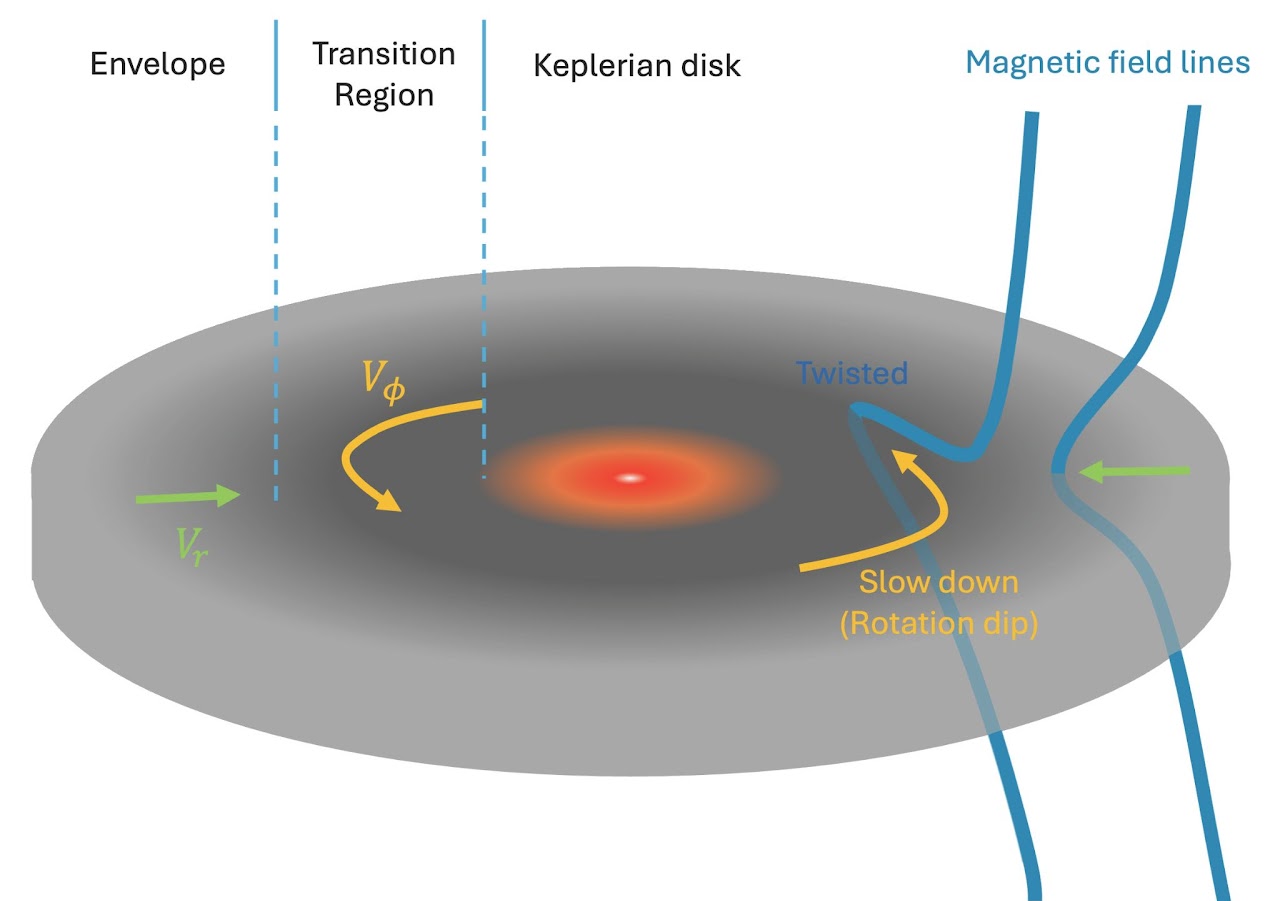
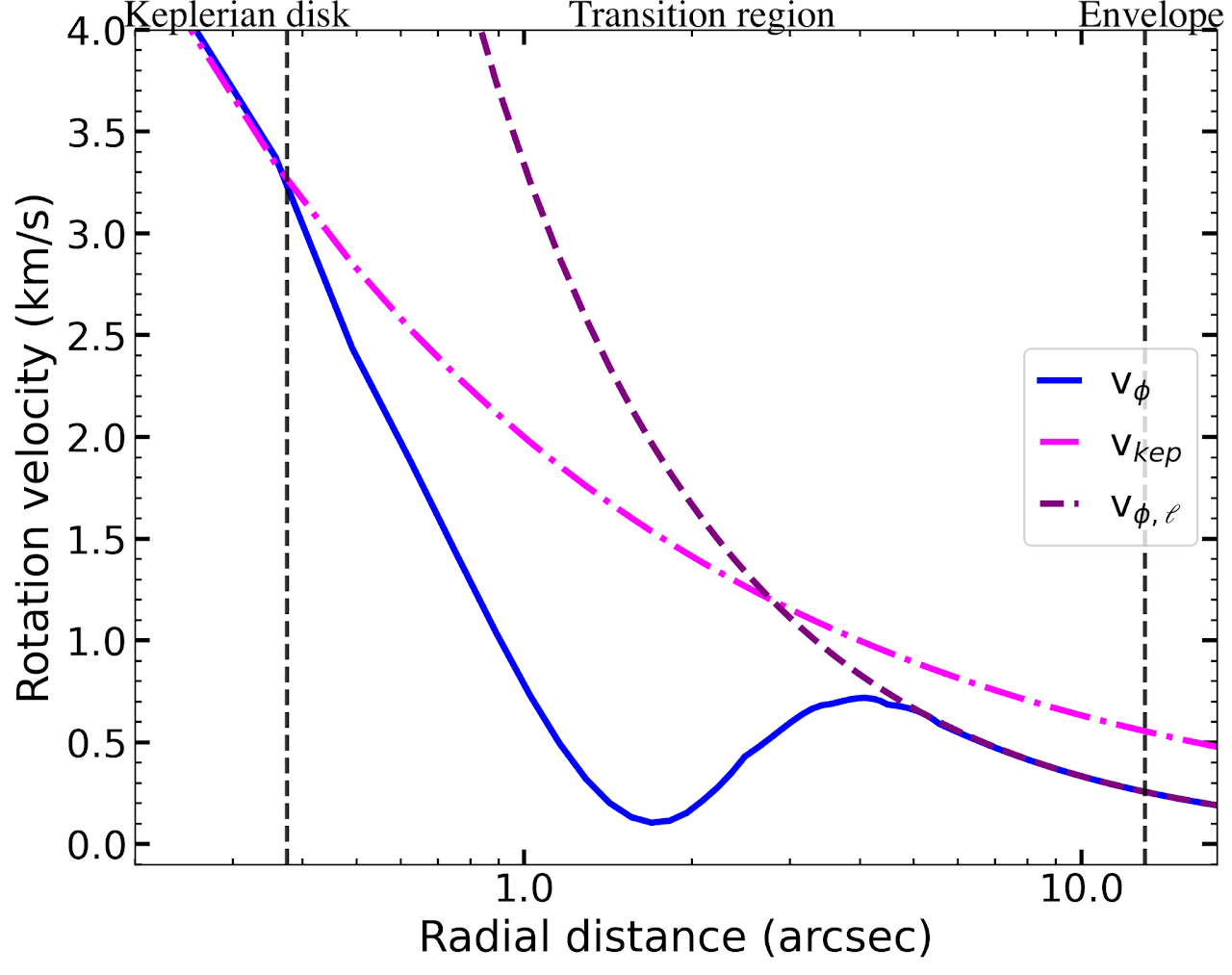
Using observational data that cover a more complete range of spatial scales, the team was able, for the first time, to clearly detect a sudden drop in gas rotation velocity at the transition between the envelope and the Keplerian disk. The team found that at a radius of about 600 au from the protostar, the rotation velocity of the gas is only about 95% of the value expected from angular momentum conservation, forming a feature known as a “rotation dip.” This indicates that a mechanism is efficiently transporting angular momentum from the inner regions to the outer regions, with the most plausible explanation being magnetic braking caused by magnetic fields.
As the rotating gas spins rapidly and collapses inward, it drags surrounding magnetic field lines with it. This interaction generates a force from the magnetic field that acts like a rubber band pulling on the gas, slowing its rotation and allowing the gas to continue accumulating inward to form an accretion disk. These observational results are highly consistent with magnetohydrodynamic (MHD) simulations, allowing astronomers, for the first time, to directly witness how magnetic braking affects gas motions and removes angular momentum in a protostellar system.
This result not only helps us better understand how stars and planetary disks are formed, but also brings us closer to uncovering the key processes involved in the early formation of our Solar System. In the future, combining these observations with polarization measurements of both the envelope and the accretion disk will allow astronomers to directly map the structure of magnetic fields and further confirm the role of magnetic braking in star formation.
"Clear velocity changes at the envelope–disk transition have been difficult to observe. This discovery highlights the key role of magnetic fields in star formation, and we hope to identify similar signatures in more systems,” said Jyun-Heng Lin, currently a graduate student at National Tsing Hua University and the lead author of this study.
"Using higher-resolution ALMA observations, we have followed up on this system and resolved the region where this angular-momentum decrease occurs," commented Chin-Fei Lee, the deputy director of ASIAA.
在恆星形成的過程中,原恆星周圍會逐漸形成一個吸積盤。這個吸積盤是外圍包層中的氣體向內塌縮、累積而成。然而,旋轉中的氣體若轉速過快,將無法被恆星的重力有效束縛,反而會被甩向外層。觀測顯示,多數低質量原恆星周圍的吸積盤半徑通常只有約10到100天文單位,這意味著在氣體由包層進入吸積盤的過程中,必須存在某種機制,能有效移除多餘的角動量。天文學家長期以來推測,磁場透過所謂的「磁煞車」(magnetic braking)在其中扮演關鍵角色,但過去一直缺乏直接的觀測證據。
在中央研究院天文及天文物理研究所(ASIAA)李景輝特聘研究員的指導下,當時就讀於國立臺灣師範大學(NTNU)大學部的學生林雋恒,利用位於智利高原的阿塔卡瑪大型毫米及次毫米波陣列(ALMA),透過C¹⁸O(J=2–1)分子譜線,繪製年輕恆星形成系統HH 111 VLA 1的結構。HH 111 VLA 1位於獵戶座,是一個深嵌於向內塌縮包層中的原恆星系統,周圍擁有一個半徑約160天文單位的顯著吸積盤。先前的研究已指出,在吸積盤形成之前,包層中的氣體角動量便已出現明顯下降。
透過涵蓋範圍更完整的觀測資料,本研究首次清楚捕捉到氣體在包層與吸積盤交界處,旋轉速度突然下降的現象。我們發現在距離恆星約600天文單位的位置,氣體的旋轉速度僅約為角動量守恆理論預期值的95%,形成一個明顯的「減速帶」(rotation dip)結構。這顯示在該區域存在一股力量,正將角動量由內側氣體傳遞至外層,而最合理的解釋,正是磁場透過磁煞車所產生的作用。
當氣體高速旋轉時,會拖曳周圍的磁力線,使磁場產生反作用力,如同被拉緊的橡皮筋一般抑制氣體旋轉,進而降低其轉速。這使得氣體得以繼續向內聚集,順利進入吸積盤並促進恆星成長。這項觀測結果與多項磁流體動力學模擬高度一致,讓我們首次在實際天體中,直接看見磁煞車如何影響氣體運動並帶走角動量。
這項成果不僅有助於釐清恆星與行星盤的形成機制,也讓我們更接近理解太陽系早期誕生的關鍵過程。未來若能結合包層與吸積盤中的偏振觀測,將可直接描繪磁場的形狀與結構,進一步驗證磁煞車在恆星形成過程中的角色。
論文第一作者、目前為國立清華大學碩士生的林雋恒表示:「過去在包層與吸積盤的過渡區域中,要觀測到如此明顯的速度變化相當困難。這項發現突顯了磁場在恆星形成過程中的關鍵作用,也讓我們有機會在更多系統中尋找類似的現象。」
中研院天文所副所長李景輝指出:「透過更高解析度的ALMA觀測,我們得以進一步追蹤這個系統,並清楚解析角動量下降發生的具體位置